Friday, 23 August 2013

Anxiety pathway discovered

Brain circuit that controls anxiety levels discovered

Research could help find better drugs to treat anxiety.
August 23, 2013
[+]
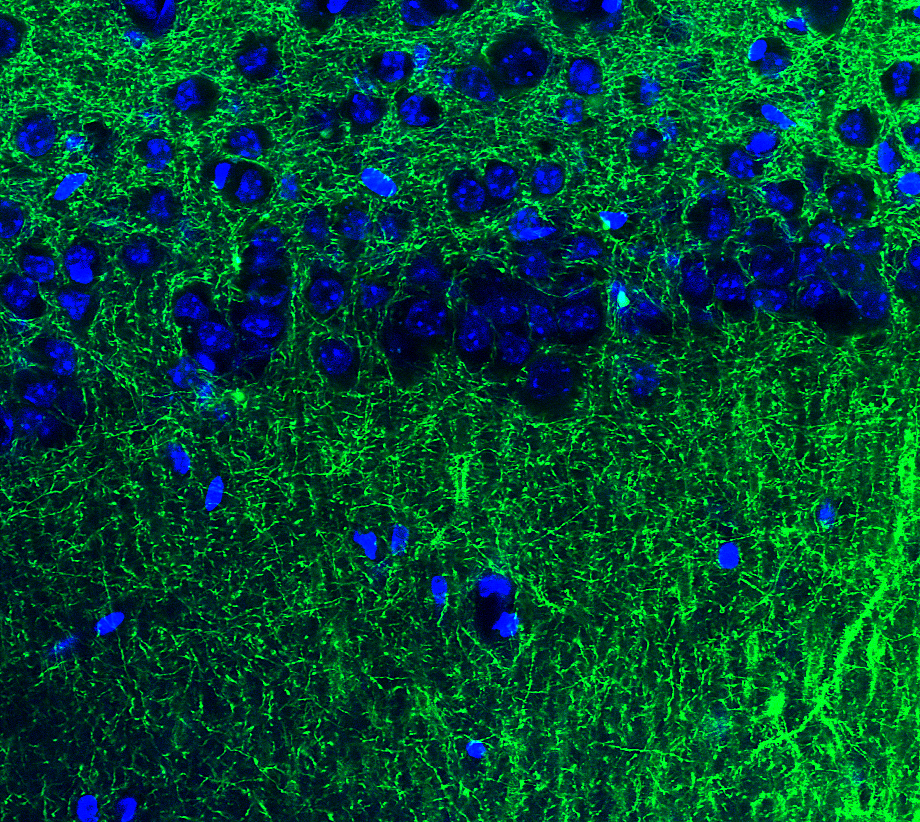
The tips of long neuronal extensions from the amygdala (green) contact neurons of the hippocampus (blue). This communication pathway helps to modulate anxiety. (Credit: Ada Felix-Ortiz/MIT)
Researchers at MIT’s Picower Institute for Learning and Memory  havediscovered a communication pathway between two brain structures — the amygdala and the ventral hippocampus — that appears to control anxiety levels.
By turning the volume of this communication up and down in mice, the researchers were able to boost and reduce anxiety levels. The research could help find better drugs to treat anxiety.
Measuring anxiety
Both the hippocampus, which is necessary for memory formation, and the amygdala, which is involved in memory and emotion processing, have previously been implicated in anxiety. However, it was unknown how the two interact.
To study those interactions, the researchers turned to optogenetics, which allows them to engineer neurons to turn their electrical activity on or off in response to light. For this study, the researchers modified a set of neurons in the basolateral amygdala (BLA); these neurons send long projections to cells of the ventral hippocampus.
The researchers tested the mice anxiety levels by measuring how much time they were willing to spend in a situation that normally makes them anxious. Mice are naturally anxious in open spaces where they are easy targets for predators, so when placed in such an area, they tend to stay near the edges.
When the researchers activated the connection between cells in the amygdala and the hippocampus, the mice spent more time at the edges of an enclosure, suggesting they felt anxious. When the researchers shut off this pathway, the mice became more adventurous and willing to explore open spaces. However, when these mice had this pathway turned back on, they scampered back to the security of the edges.
In future studies, the MIT team plans to investigate the effects of the amygdala on other targets in the hippocampus and the prefrontal cortex, which has also been implicated in anxiety.
“The practical use of this innovation is the identification of a novel target for potential anxiety treatment,” Kay Tye, an assistant professor of brain and cognitive sciences and member of MIT’s Picower Institute for Learning and Memory, explained to KurzweilAI. “While the time frame to translation to a treatment that could be used in humans is difficult to predict, we are taking the first step in developing more effective treatments for anxiety: identifying the critical neural substrates involved in controlling anxiety states.”
Anxiety disorders, which include post-traumatic stress disorder, social phobias and obsessive-compulsive disorder, affect 40 million American adults in a given year. Currently available treatments, such as antianxiety drugs, are not always effective and have unwanted side effects.
The research was funded by the JPB Foundation, the Picower Institute Innovation Fund, the Whitehall Foundation and the Klingenstein Foundation.
Related:

Friday, 9 August 2013

stress


MONDAY, AUGUST 05, 2013

The bad kind of stress - perceived helplessness

Velasquez-Manoff does a nice discussion of a topic that has been recurrent in MindBlog, understanding the kind of stress that is really bad for us. Not the stress that goes with daily personal and professional aggravations, but the long term stress that derives from feeling helpless to control our lives. Numerous studies, the best known being a long term study of British civil servants, have shown that being higher in a social hierarchy correlates with having better health. The sense of control:
...tends to decline as one descends the socioeconomic ladder, with potentially grave consequences. Those on the bottom are more than three times as likely to die prematurely as those at the top. They’re also more likely to suffer from depression, heart disease and diabetes. Perhaps most devastating, the stress of poverty early in life can have consequences that last into adulthood.
The article quotes Robert Sapolsky at Stanford, whose classic book "Why Zebras Don't Get Ulcers" is still a must read, as saying:
Early-life stress and the scar tissue that it leaves, with every passing bit of aging, gets harder and harder to reverse...You’re never out of luck in terms of interventions, but the longer you wait, the more work you’ve got on your hands.
Bruce McEwen and others talk about
...the “biological embedding” of social status. Your parents’ social standing and your stress level during early life change how your brain and body work, affecting your vulnerability to degenerative disease decades later. They may even alter your vulnerability to infection. In one study, scientists at Carnegie Mellon exposed volunteers to a common cold virus. Those who’d grown up poorer (measured by parental homeownership) not only resisted the virus less effectively, but also suffered more severe cold symptoms.
Another clip:
Animal studies help dispel doubts that we’re really seeing sickly and anxiety-prone individuals filter to the bottom of the socioeconomic heap. In primate experiments females of low standing are more likely to develop heart disease compared with their counterparts of higher standing. When eating junk food, they more rapidly progress toward heart disease. The lower a macaque is in her troop, the higher her genes involved in inflammation are cranked. High-ranking males even heal faster than their lower-ranking counterparts. Behavioral tendencies change as well. Low-ranking males are more likely to choose cocaine over food than higher-ranking individuals.
Finally:
...while Americans generally gained longevity during the late 20th century, those gains have gone disproportionately to the better-off. Those without a high school education haven’t experienced much improvement in life span since the middle of the 20th century. Poorly educated whites have lost a few years of longevity in recent decades.
A National Research Council report, meanwhile, found that Americans were generally sicker and had shorter life spans than people in 16 other wealthy nations. We rank No. 1 for diabetes in adults over age 20, and No. 2 for deaths from coronary artery disease and lung disease. The Japanese smoke more than Americans, but outlive us — as do the French and Germans, who drink more. The dismal ranking is surprising given that America spends nearly twice as much per capita on health care as the next biggest spender.